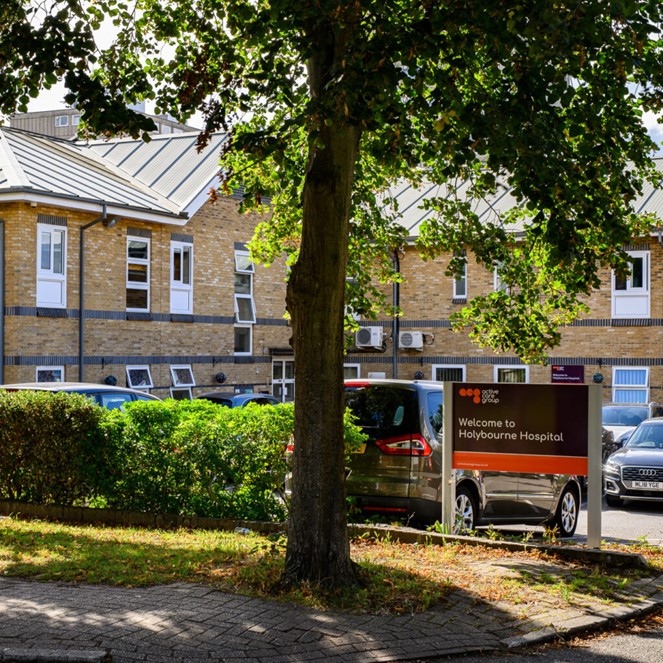
Report on Holybourne Hospital, Acute mental health service for adults.
What we did
This report is a result of a collaborative project undertaken by Healthwatch Wandsworth and Healthwatch Richmond upon Thames.
Healthwatch has the statutory authority to visit local health or social care services, using trained Enter and View volunteers, with the main focus on service users’ and carers’ experience of care
Holybourne Hospital (formerly Huntercombe Hospital) in Roehampton was originally used as a Psychiatric Intensive Care Unit (PICU) by the Huntercombe Group but transitioned to its new identity as an Adult Acute unit under the Active Care Group (ACG) around 2022/23.
Holybourne Hospital cares for NHS patients referred by South West London and St George’s Mental Health Trust (SWLSTG).
We conducted Enter and View visits to Holybourne in order to provide independent insight to service providers, commissioners, and the general public. This insight concerns patient experiences of the care provided as part of the SWLSTG pathway.
We also wanted to speak to staff about their experience of working at Holybourne and for Active Care Group.
We conducted two Enter and View visits in which we spoke to patients and staff on the wards:
- Thursday 25th September 2025 - we visited all three wards in use, Barnes, Richmond and Kingston
- Tuesday 28th October 2025 – we visited two out of three wards in use, Barnes and Kingston
What we found
- Most patients were generally very satisfied with the support from therapy staff and the activities associated with this.
- The majority of patients felt the activities on offer could be improved.
- Some patients were not aware of aspects of their care plans.
- Two patients reported a lack of consistent recognition of serious dietary restrictions.
- The majority of care staff were passionate about working at Holybourne to help patients get better.
- Some staff reported issues in the organisational culture.
- We witnessed some instances of concerning behaviour from care staff on the wards.
- There was a general “uninviting” environment on the wards due to low ceilings, fluorescent lighting and a lack of natural light.
Further detail on our findings can be found in the full report in Section 3.
Our recommendations
- Improve the consistency of kindness and compassion that care staff treat patients with, particularly on Kingston Ward.
- Improve the organisational culture at Holybourne, including but not limited to: staff gossip and consistency between staff ward teams.
- Improve the range and frequency of activities offered to patients, especially on weekends.
- Improve the ward environments.
- Ensure that patients are kept informed about their care plans, including why they are taking each specific medication.
- Ensure that patients dietary requirements are respected by all staff and that food meets patients’ dietary requirements.
- South West London and St George's Mental Health NHS Trust (SWLSTG) to ensure their contract monitoring of Holybourne Hospital has Key Performance Indicators (KPIs) that monitor patient experience
The detail behind these recommendations and their potential impact can be found in the full report in Section 4.
Official Response from Holybourne Hospital Management
‘I want to thank [Healthwatch Wandsworth and Healthwatch Richmond] for taking the time to visit and understand Holybourne Hospital and for the time your team have taken to ensure the report is accurate and detailed. I also want to thank you for the opportunity to address the outstanding issues.
Kind regards,
Steve Bradford
Hospital Director'
The full response of Holybourne Hospital Management to our recommendations can be found in the full report in Section 5.
Official Response from from South West London and St George's Mental Health NHS Trust (SWLSTG)
‘Since the visit, the issues raised in the report have been tracked through monthly contract and operational meetings, including progress against actions which are closely monitored by SWLSTG Senior Managers of this group.
The Hospital Director confirmed that the Healthwatch action plan has been finalised and the team is in the process of completing the associated action plan involving both patients and staff.’
The full response from SWLSTG to our recommendations can be found in the full report in Section 6.