Unzippd GP Practice Pilot: Capturing Deaf British Sign Language (BSL) Patient Feedback and Service Barriers
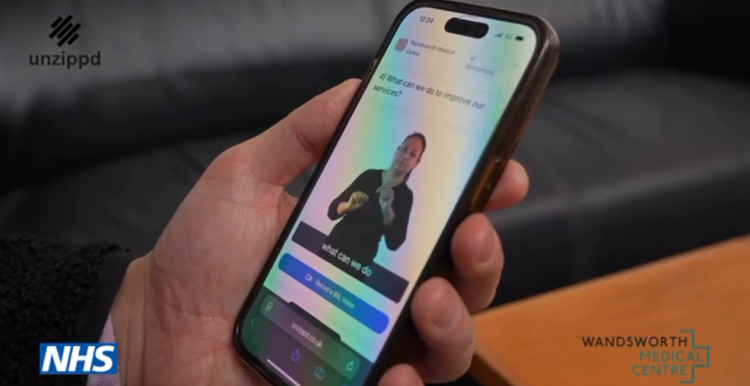
Unzippd is a BSL Survey Platform designed to gain insights into the Deaf experience in the way Deaf people want to give them.
Their pilot across two Wandsworth GP practices coincides with the "Locked Out" report (2025), which highlighted a national £1.2 billion annual waste in NHS spending due to communication failures and a BSL mental health morbidity rate of 45%.
Unzippd’s findings demonstrate that providing a BSL-integrated entry point transforms the BSL community from "statistically invisible" to the most engaged patient demographic in the borough. This engagement confirms that the previous lack of data was a failure of the feedback mechanism, not a lack of patient interest.
Patient feedback received by Unzippd during GP Practice Pilot
In the 60-day period between December 1, 2025, and February 1, 2026, the pilot recorded 62 Responses from 13 BSL respondents.
The qualitative data identified the specific points where the patient journey breaks down, highlighting that access issues often occur outside of the clinical consultation.
- Reception Barriers - Reports of positive staff attitudes undermined by the physical absence of an interpreter during the booking process. (touch points outside of consultation)
- Digital Access - Deaf patients want to be able to message the surgery in BSL and get a reply back later, rather than being forced to travel there in person just to book an appointment, cancel one, or get assurance that their meeting is actually going ahead.
- Interpreter Efficacy - Frequency of complaints regarding interpreter "no-shows" and a desire for patient-led choice of specific professionals
The qualitative data reveals that the "communication chain" frequently breaks at the administrative entry point of the practice. While reception staff are often viewed positively, the lack of an interpreter during the booking and enquiry stage creates an immediate barrier that prevents independent access. Deaf patients want to be able to message the surgery in BSL and get a reply back later, rather than being forced to travel there in person just to book an appointment, cancel one, or get assurance that their meeting is actually going ahead.
This pilot has successfully surfaced "invisible data" that has never been available to practices and the Integrated Care Board (ICB). For the first time, commissioners have a dataset that exposes the reality of service delivery versus the statistics provided by interpreter agencies. Current agency reporting typically only captures the "fulfilment rate," which fails to provide an accurate picture of the actual patient experience or specific frustrations.
This creates a new baseline for accountability. By adding these contact tools to the standard commissioning model, the ICB can move away from "blind" procurement and towards a model built on informed, user-led knowledge. This allows the ICB to target the specific gaps that current contracts miss, as agencies are currently only paid to provide interpreters for the actual doctor’s appointment, leaving the admin process unsupported. Focusing here is the way to stop the financial wastage caused by "no-shows" and booking errors while restoring independence for Deaf patients.
Related Reports
The Delivery of the Accessible Information Standard (AIS) in South West London GP Practices
As part of South West London Healthwatch we engaged patients, carers of patients, and GP staff to understand how well GP practices deliver the AIS, and the barriers and enablers to delivery.
Key Findings
- Lack of Awareness – 73% of patients and carers did not know about the AIS.
- Inconsistent Recording of Communication Needs – While some patients had positive experiences, many reported having to repeat their communication needs at each visit.
- Reliance on Family or Charities – Many patients relied on carers, family members, or charities to navigate GP communication, raising concerns about independence, privacy, and accessibility.
- Challenges for GP Staff – Staff highlighted issues with effectively flagging communication needs in medical records due to system limitations. Some reported a need for more training, resources, and support.
- BSL Interpretation Barriers – Patients using British Sign Language (BSL) faced delays in getting an appointment, due to delays in booking interpreters.
Key Recommendations
- Awareness of the AIS is low among patients and carers. Healthwatch, voluntary sector organisations, and others should support communication campaigns to inform people of their rights.
- GP staff requested clear, standardised communication resources (e.g., easy read materials, BSL videos) from South West London Integrated Care Board.
- The new BSL interpretation service introduced in October 2024 (after we conducted this research) should be evaluated based on the experiences of people who use BSL.
- A new reasonable adjustments flagging system in EMIS was introduced in December 2024, and its impact on improving patient communication should be assessed.
- Regular disability equality and Accessible Information Standard training for GP staff can improve patient communication and accessibility.
- GP practices should create an environment where patients know longer appointments are available and can express their wishes for one.
- Deaf and hard-of-hearing patients often must follow up on BSL interpreter bookings, and providing timely updates can help reduce this extra burden.
The "Locked Out" report (2025) by the British Sign Language (BSL) Advisory Board, a non-statutory government board, identified three critical failures in healthcare access for BSL users:
Key Findings
- Linguistic Exclusion: For the majority of BSL users, English is a second language. Relying on written feedback forms such as the standard NHS Friends and Family Test (FFT) creates a linguistic barrier that fundamentally excludes Deaf patients from giving feedback.
- The Data Vacuum: There is a persistent lack of routine data recording. Without independent, BSL-accessible feedback mechanisms, the NHS cannot identify the scale of unmet need, leaving BSL users invisible within larger health datasets.
- Procurement vs. Delivery: Even where interpreter services have been procured, there is no consistent mechanism to verify if these resources are effectively reaching the patient at the point of care.
Key Recommendations
- Prioritize Co-Design: Progress can only be achieved when services are developed in partnership with the communities they aim to serve.
- Investment in BSL Access: There is a compelling economic case for proactive measures in early intervention and effective BSL communication to lead to significant long-term savings.
- Mandatory Data Collection: It is incumbent on commissioners to prioritise BSL provision and secure the "missing data" required to identify and address health and social inequalities.
Opportunity for BSL Feedback at Healthwatch Wandsworth
As an organisation focused on ensuring we find out what local people think, what matters to them, and make sure that their views shape health and care services in Wandsworth, we are aware that being accessible to as many communication needs as possible.
As a result we are working with Unzippd to allow BSL users to share their experiences with us in their native language.